Joop Varekamp
Teaching Assistants: Festo Lugolobi
The role of CO2 in earth processes is very large relative to the modest quantities of it that are present in the atmosphere. In this course we will study all aspects of the role of CO2 in Climate Change, which involves the physics, chemistry and biology of CO2. The class has four class projects: atmospheric CO2 monitoring, plant growth and its impact on atmopsheric CO2, air-water CO2 exchange and computer models of the carbon cycle.
The E&ES CO2 monitoring site will begin
collecting data when the course starts. We will compare the Wesleyan CO2
record with those from elsewhere and interpret variations in measured CO2
contents at different time scales (day/night; weekly, seasonal, long-term)
in terms of local and regional fluxes of CO2. We will extract
CO2 databases from the WEB and replot them with our data, calculate
fluxes of absolute amounts from data series, and other computer exercises.
We will also do some class lab exercises with the program
SIMEARTH - you can manipulate the intensity of the sun, the extent of the
biosphere, atmospheric CO2 and more, and create your own ice
ages and global warming scenarios.
Student groups will create scenarios of global warming
for emission densities of CO2 in the world, and write essays or
give presentations on scientific and political aspects.
Topics that will be addressed in this course:
What is the role of CO2
in global climate (greenhouse gas)?
How does photosynthesis work?
How does CO2 acidify
surface waters?
How has atmospheric CO2
varied over the course of earth's history?
How much CO2 is arriving at the earth surface from volcanic activity?
How much CO2 is there
on other planets?
What should we do to prevent further
global warming - the Kyoto treaty
SOME USEFUL WEB LINKS:
Carbon EMISSION TRENDS
GLOBAL WARMING
EPA's Global Warming Site
ENN
Ocean warming
CLIMATE AND
CO2
photosynthesis diagrams
Lecture notes PHOTOSYNTHESIS
Urinary bicarbonate
effects
CO2's relationship with pH
planetary
CARBON inventory
CO2 and Global Climate Change
CO2 Cycling
SNOWBALL
EARTH
CLIMATES OF THE
PAST
A
TEMPERATURE RECORD
PLANTS
THE WEATHERING NOTES
Kyoto
protocol
To learn more about Earth Science go to the UC Berkeley Geology website
To learn more about photosynthesis in the oceans, go
to Emiliani
Huxleyi
Problem Sets.
I. Calculate the "blackbody temperatures" of Venus, Earth and Mars, using Wien's Law, Boltzmann's Law, the inverse-square relationship between radiation of the sun and distance to the planets and the 'colour' of the sun (lambda =0.48 micrometer). You obtain the blackbody temperature of a planet by stating: heat-IN = heat-OUT and neglecting albedo and greenhouse effects.
Wien's Law : lmax
T = Cw (T in degrees Kelvin)
Boltzman's Law: E = s
T4 (E in W/m2)
- This law gives the energy emission density for a spherical, black body
at a given temperature T. So once you determine the solar constant for
the different planets, you have to smear the solar heat out over the whole
spherical surface. After you have done that, you will obtain the amount of
heat absorbed from the sun per m2 per time unit averaged over a year.
Then solve for T(planet) by using that energy, applying IN = OUT.
s = 5.67 10-8 W/m2 K-4
Cw = 0.289 cm K
Sun radius = 700,000 km, Sun-Venus = 108 million
km, Sun-Earth = 150 million km,
Sun - Mars = 228 million km.
Observed mean surface temperatures: Venus: 430
C, Earth: 15 C, Mars: -45 C
********************************************************************************************
Course Outline :
==>Introduction on climate change, time scales
of climate change, external forcings, response times on forcings, Venus-Earth-Mars:
3 planets - three climates READING: climate on planets.
==> CLIMATE FUNDAMENTALS (HANDOUTS+TEXTBOOK)
notes on climate fundamentals Climate.html
Ellen Thomas lecture on climate proxies, Carbon and Oxygen isotopes, and her snowball earth lecture
Lecture notes Ellen Thomas on Clathrates and Paleocene warming
==> The earth climate record (long-term) and variations
in atmospheric CO2
(articles)
==> CO2 Forms of CO2 on earth - CO2 gas, H2CO3 and other species in water; carbonate equilibria; limestone Lecture notes 1 + 2
==> The carbon cycles: The long and the short carbon cycle, limestones, chemical weathering Lecture notes 3+4 . The long carbon cycle - readings
==> The Black
Sea - an environment loaded with organic carbon
second black
sea link
==> The photosynthetic process, C3 and C4 pathways, energy, chemistry
==> The isotopes of carbon 14C, 13C
and 12C, formation, applications
Isotopes
of Carbon
==> The human impact: Increase in CO2
levels since AD 1850, ice core records, comparison with last 20,000 years
Monitoring CO2 Techniques for monitoring, analytical devices, computer data storage
Local versus global signals, mixing times of the atmosphere,
problems with public policies
Limiting CO2 emissions The CO2
treaties (Rio de Janeiro, Kyoto)
CO2 disposal Burial in aquifers, deep ocean
storage
CO2 sequestration in
the deep ocean
Conclusions
websites that deal with IPCC forecasts, local
effects and skeptics (your handout)
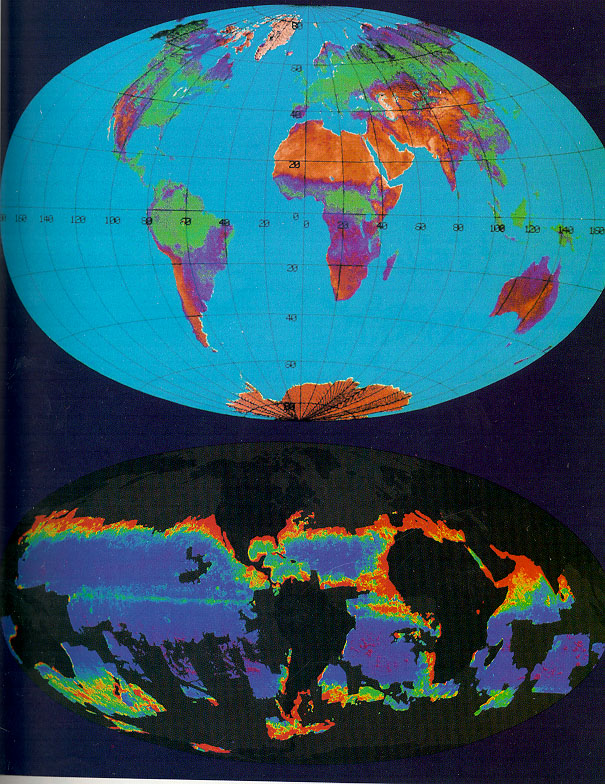
False colour images of the world indicating the abundance
of chlorophyl ("plants") on land and in the oceans
Upper figure-Terrestrial Productivity: green areas have
high biomass density, orange have few plants
Lower Figure-Ocean Productivity: red zones: highest chlorophyl
concentrations; blue lowest chlorophyl concentrations